Health Benefits of Microgreens: What Does the Research Actually Say?
Microgreens are young, edible plants harvested soon after the first true leaves appear. They have attracted a surprising amount of scientific attention for such a small vegetable — so it is worth asking what the published research actually shows, and where it stops short.
Sprinkle Greens · Updated: 3 September 2026
Search for microgreens online and you will find long lists of health benefits, usually stated with more confidence than the science supports. The honest version is more interesting. Laboratory analyses show that many microgreens contain meaningful amounts of vitamins, minerals, carotenoids, polyphenols, glucosinolates and anthocyanins — the families of plant compounds nutrition researchers care about. What those measurements do not do is prove a health outcome in people.
Composition also varies a great deal. Species, growing conditions, light, substrate and the exact stage at harvest all shift the numbers, which is why researchers keep emphasising that microgreens are not one uniform food (Kyriacou et al., 2016, review). If you are new to the category altogether, our plain-language explainer on what microgreens are is a good place to start.
This article walks through the evidence by type — composition, cell studies, animal studies and human studies — and is deliberately clear about which is which. Nothing here is medical advice, and none of it suggests microgreens treat, prevent or cure any condition.
What Makes Microgreens Nutritionally Interesting?
In the days after germination, a seedling is doing two things at once: using up the reserves stored in the seed, and building the machinery it needs to photosynthesise. That means rapidly assembling pigments and protective compounds — chlorophyll, carotenoids, phenolic compounds — in a very small amount of tissue. Because these young leaves have not yet accumulated much water-heavy structural bulk, concentrations of some nutrients per gram of fresh weight can be relatively high (Kyriacou et al., 2016, review; Zhang et al., 2021, review).
That is a general tendency, not a rule. Two points come up repeatedly in the literature:
- Species matters enormously. A radish microgreen and a sunflower microgreen are different plants with different biochemistry, and their nutrient profiles are not interchangeable.
- Growing conditions matter too. Light intensity and spectrum, substrate, nutrient supply and harvest stage all influence measured levels of vitamins and phytochemicals.
Vitamins, Minerals and Carotenoids in Microgreens
The most frequently cited study in this field is Xiao, Lester, Luo and Wang (2012), published in the Journal of Agricultural and Food Chemistry. The researchers assessed 25 commercially available microgreen varieties and measured ascorbic acid (vitamin C), tocopherols (vitamin E), phylloquinone (vitamin K1), beta-carotene, lutein/zeaxanthin and violaxanthin.
Two findings from that paper are worth stating precisely. First, the varieties differed substantially from one another across every nutrient measured — the spread between the lowest and highest varieties was large. Second, certain individual varieties stood out for particular nutrients; red cabbage microgreens, for instance, were among the highest for vitamin C in that sample, while green daikon radish microgreens were notably high in vitamin E.
What the study does not support is a blanket statement that all microgreens are rich in all of these nutrients. It is a variety-by-variety picture, and the authors present it that way.
Minerals
A later analysis by the same research group looked specifically at minerals across 30 brassica microgreen varieties, reporting measurable levels of elements including potassium, calcium, magnesium, iron and zinc, again with clear differences between varieties (Xiao et al., 2016). Mineral content in young greens is influenced by the growing substrate and nutrient solution, so it is a property of a growing system as much as of a species.
Antioxidants and Bioactive Plant Compounds
“Antioxidant” describes a chemical behaviour: a molecule that can neutralise reactive, unstable molecules called free radicals. “Phytochemicals” is the umbrella term for the many non-nutrient compounds plants make. Several families of these have been measured in microgreens:
- Carotenoids — the orange, yellow and red pigments such as beta-carotene, lutein and zeaxanthin, quantified across many microgreen varieties (Xiao et al., 2012).
- Polyphenols — a large group including flavonoids and phenolic acids; UHPLC-based profiling has identified a wide range of them across five brassica microgreen species (Sun et al., 2013).
- Anthocyanins — the water-soluble pigments behind red and purple leaves, also a subgroup of polyphenols (Sun et al., 2013).
- Glucosinolates — sulphur-containing compounds characteristic of the cabbage family, discussed in more detail below.
Here is the distinction that most online articles blur. When a paper reports “high antioxidant activity”, that is almost always a laboratory assay: an extract of the plant is tested for its ability to neutralise radicals in a tube, producing a number such as an ORAC or DPPH value. That number describes the extract's chemistry.
It does not tell you whether the compounds survive digestion, whether they are absorbed, what your body converts them into, or whether any of that changes a health marker. Those are separate questions answered only by human studies. A high antioxidant value is a reason for researchers to look further — not evidence of a benefit to you.
Four Kinds of Evidence, Not One
Because so much confusion comes from mixing these up, it helps to keep the categories separate as you read.
Composition studies
Measure what is in the plant — vitamins, minerals, carotenoids, polyphenols. This is where most microgreen research sits, and it tells us about the food, not about health outcomes.
Laboratory and cell studies
Test extracts or isolated compounds in a test tube or on cultured cells. Useful for understanding chemistry and possible mechanisms; they cannot show what happens in a person eating a salad.
Animal studies
Feed microgreens or their compounds to animals, often on controlled diets. They can suggest direction and mechanism, but doses, metabolism and diets differ from ours.
Human studies
The level that can actually establish a health outcome. For microgreens specifically, this evidence is still comparatively limited.
Potential Cardiovascular Interest
Researchers are interested in microgreens and cardiovascular health for an indirect reason: the nutrients and compounds these greens contain — potassium, vitamin K, carotenoids, polyphenols, dietary fibre — belong to the same category of plant constituents studied for decades in relation to blood lipids, blood pressure and vascular function in vegetable-rich diets generally.
The most direct microgreen-specific finding comes from an animal study: Huang and colleagues (2016) fed red cabbage microgreens to mice on a high-fat diet and reported lower circulating LDL cholesterol, lower liver cholesterol and reduced levels of certain inflammatory signalling molecules compared with control animals. It is a well-cited paper and a genuine result — in mice, on a controlled experimental diet.
That is a mechanistic and hypothesis-generating finding, not a clinical one. Mice differ from humans in metabolism and diet, the quantities used in feeding studies are not everyday portions, and no equivalent large-scale human trial of microgreens on cardiovascular endpoints exists. Early research indicates a direction worth investigating; it does not show that eating microgreens prevents or treats heart disease, and nobody should treat it that way.
Microgreens and Metabolic Health
A related strand of research looks at metabolic markers: blood glucose regulation, oxidative stress and the enzyme pathways involved in handling both. The interest again comes from compound classes rather than from microgreens as such — polyphenols and glucosinolate-derived compounds have been studied for their effects on carbohydrate-digesting enzymes, glucose uptake in cultured cells and antioxidant defence pathways.
Reviews of microgreen research summarise these findings as promising but preliminary, drawn largely from laboratory and animal models (Zhang et al., 2021, review; Ebert, 2022, review). Promising laboratory or animal results do not automatically establish a clinical benefit in humans: the step from “this compound affects an enzyme in a dish” to “this food changes an outcome in people” is exactly the step most candidate findings fail.
Why Broccoli Microgreens Get So Much Scientific Attention
If one microgreen dominates the literature, it is broccoli — and the reason is a class of compounds called glucosinolates. These sulphur-containing molecules are characteristic of the Brassicaceae family: broccoli, cabbage, radish, mustard, pak choi, kale.
Glucosinolates are stored inert. When plant tissue is damaged — chewed, chopped, crushed — an enzyme called myrosinase is released and converts them into active products, most notably isothiocyanates. The best-known of these is sulforaphane, derived from a glucosinolate called glucoraphanin.
The landmark work here is Fahey, Zhang and Talalay (1997) in PNAS, which reported that young broccoli sprouts contained considerably higher concentrations of glucoraphanin than mature broccoli heads, and that extracts were potent inducers of what are called phase II detoxification enzymes in cell-based assays. That is laboratory and cell research, and it is why cruciferous seedlings became a research focus in the first place.
Three qualifications matter and are often dropped:
- Sprouts and microgreens are not the same thing — they are grown and harvested differently, so findings do not transfer automatically between them. We cover the distinction in detail in our comparison of the two.
- Glucosinolate content and how much converts to isothiocyanate vary with variety, growing conditions, storage, chopping and cooking, and even individual gut microbiota. There is no fixed amount you get from a portion.
- Enzyme induction observed in cells is a mechanism, not a health outcome. Human research on isothiocyanates continues and is genuinely interesting, but outcomes in people are more complex than any cell assay.
So: broccoli microgreens contain compounds that have been extensively studied and are a good reason for scientific curiosity. They are not a dose of sulforaphane, and no responsible reading of this literature concludes that eating them prevents cancer. For the sprouts-versus- microgreens distinction, see microgreens vs sprouts.
What About Purple and Red Microgreens?
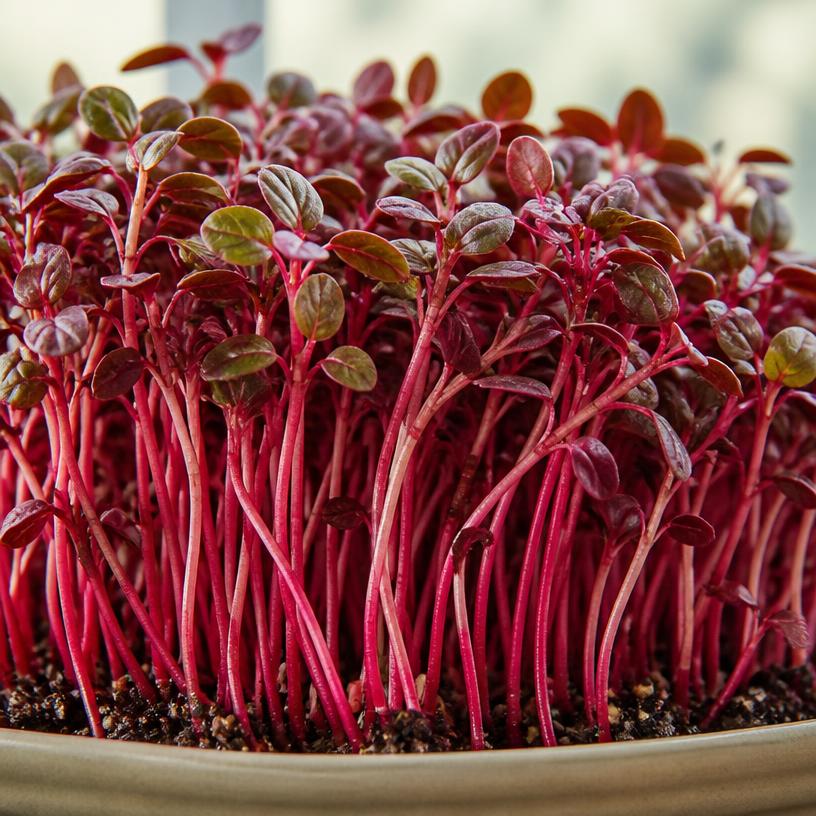
Purple and red microgreens — purple radish varieties, red cabbage, red amaranth — owe their colour largely to anthocyanins, water-soluble pigments in the polyphenol family. They are scientifically interesting because they are chemically distinct from the carotenoids that dominate green tissue, and because analytical work has mapped them in detail across brassica microgreens (Sun et al., 2013).
What colour does not do is rank a variety's overall nutritional value. A purple leaf tells you something about which pigments are present; it says nothing about vitamin C, vitamin K, carotenoid or mineral content, all of which follow the species and the growing system. In the 2012 composition study, high values for different nutrients were scattered across both green and red varieties.
The practical takeaway is the same one nutrition research keeps producing about vegetables in general: variety across the week is more useful than searching for a single best one.
Are Microgreens Healthier Than Mature Vegetables?
This is the claim that most needs tightening. The accurate version is: some microgreens can contain higher concentrations of particular nutrients or phytochemicals than their mature counterparts, but this varies substantially by species and by nutrient.
Several things complicate the comparison:
- Portion size. Concentrations are usually reported per 100 g of fresh weight, and nobody eats 100 g of microgreens at a sitting the way they might eat a serving of cooked greens.
- Which nutrient. A variety can be higher in one vitamin and lower in another than its mature form.
- Water content and dry matter differ between young and mature tissue, which changes how per-gram figures read.
- Preparation. Mature vegetables are usually cooked, which alters some nutrients up and others down.
Mature vegetables remain an important part of a healthy diet — they provide volume, fibre and a nutrient profile you cannot replicate with a garnish. The sensible way to see microgreens is as an additional way to bring more plant variety to meals you already cook, not a replacement for anything on your plate.
What the Research Does Not Prove Yet
An honest summary of this field has to include its gaps, and they are substantial.
- Most published work is compositional — it measures what is in the plant rather than what happens in people who eat it.
- A significant share of the mechanistic evidence comes from laboratory and cell studies using extracts or isolated compounds, often at concentrations unrelated to dietary intake.
- Several of the most-cited health-related findings are animal studies, which can indicate direction but not clinical effect.
- Human clinical research on microgreens specifically is comparatively limited: few trials, small numbers of participants, short durations and varied designs.
- Composition varies by species, cultivar, growing conditions and harvest stage, which makes results hard to compare and hard to reproduce across growers.
- Bioavailability — how much of a measured compound is actually absorbed and used — is still incompletely characterised for many of these compounds.
- Well-designed, adequately powered human studies are needed before specific health outcomes can be attributed to eating microgreens.
None of this makes microgreens less worth eating. It just means the reason to eat them is the same reason to eat any fresh vegetable: they add nutrients, plant variety, flavour and texture to your food.
How to Add Microgreens to Your Everyday Diet
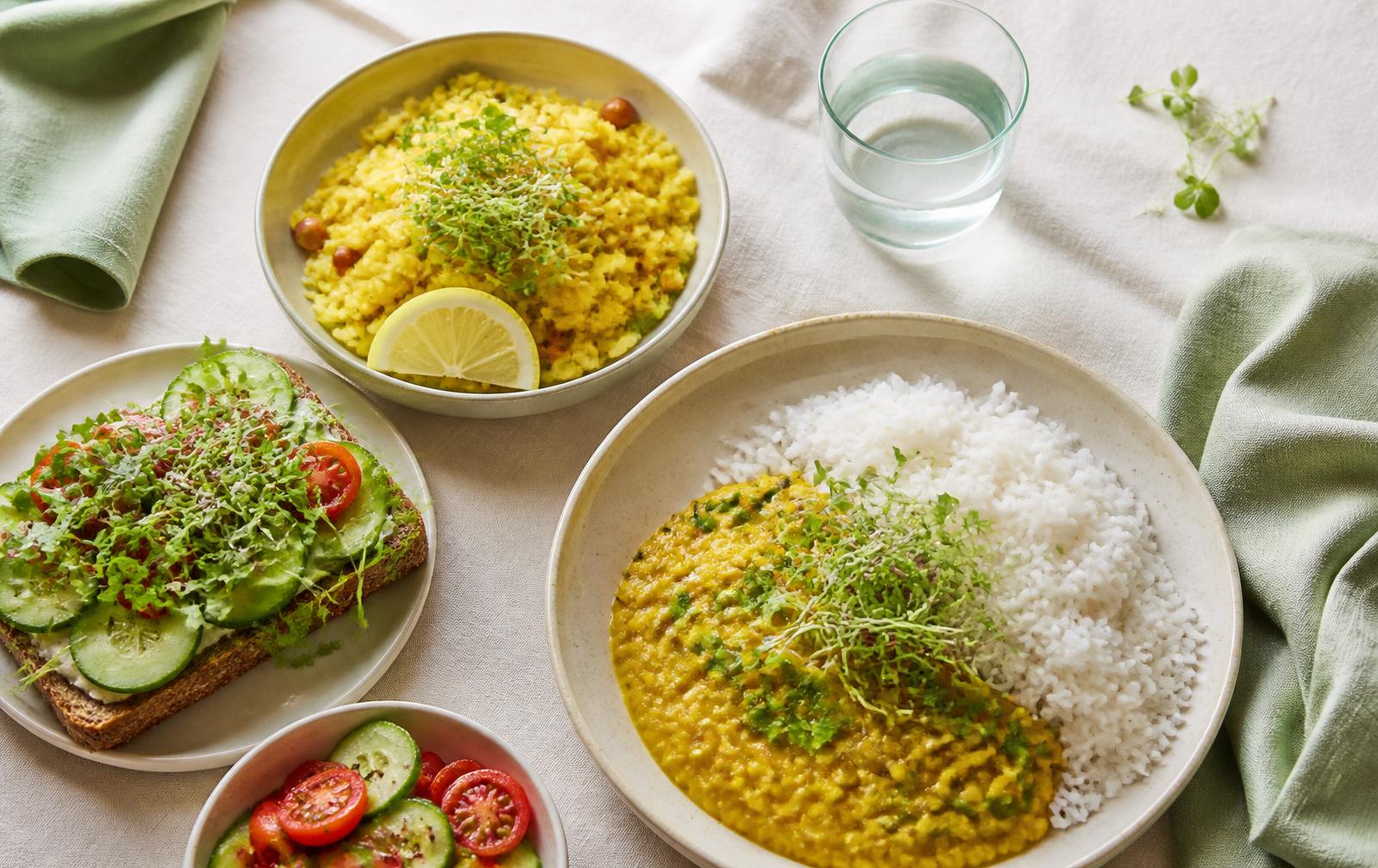
Because the leaves are tender, the easiest approach is to add them raw or right at the end of cooking. A few habits that work well in an Indian kitchen:
- Scattered over a salad, or used as the salad itself with a squeeze of lime.
- Layered into sandwiches and wraps instead of lettuce.
- On top of dosa just before you fold it.
- Stirred through poha off the heat, so they stay crisp.
- Over dal and rice, added in the bowl rather than the pot.
- On grain and rice bowls, khichdi or curd rice.
- As part of a breakfast plate — eggs, toast, upma, paratha.
- Finishing chaat, where a peppery variety works especially well.
For a longer list with specifics, our guide on easy ways to eat microgreens every day goes through fifteen of them.
Which Microgreens Should Beginners Try?
If you are starting out, flavour matters more than any nutrient table. These are the varieties we currently grow:
Broccoli
Mild and earthy; the most studied cruciferous microgreen.
Pea Shoots
Sweet, tender and easy to eat by the handful.
Sunflower
Nutty and crunchy, sturdy enough for bowls and wraps.
Radish
Peppery and crisp — a little goes a long way.
Pak Choi
Mild and crunchy, very easy to add to Indian meals.
Alfalfa
Light and delicate, pleasant raw in sandwiches.
Mustard
Sharp, almost wasabi-like; best used sparingly.
Amaranth
Deep red leaves, delicate flavour, striking on a plate.
A mild variety plus one with more bite is a good first order. Our beginner's guide to choosing varieties compares them in more detail.
Keeping Them Fresh
Nutrient content is only useful if the greens are still in good condition when you eat them. Refrigerate them soon after they arrive, keep them dry rather than wet, blot away condensation, and wash only the portion you are about to use. Judge freshness by how they look and smell rather than by a fixed number of days — that genuinely varies by variety, harvest condition and handling. Our storage guide covers the details.
Frequently Asked Questions
Microgreens are young, edible vegetable greens, and published composition studies show that many of them supply vitamins, minerals and plant compounds such as carotenoids and polyphenols. That makes them a reasonable addition to a diet built on a variety of vegetables. What research has not established is any specific medical benefit from eating them, so it is fair to describe them as a nutritious vegetable rather than a treatment for any condition.
Depending on the species, analyses have reported vitamin C, tocopherols (vitamin E), vitamin K, carotenoids such as beta-carotene and lutein, and minerals including potassium, calcium, magnesium and iron. The amounts differ widely between varieties, so no single nutrient list applies to every microgreen.
Sometimes, for particular nutrients and particular species. Some microgreens have been measured with higher concentrations of certain vitamins or phytochemicals than their mature counterparts, but this varies substantially by species and by nutrient, and it is not a universal rule. Mature vegetables remain an important part of a healthy diet.
Antioxidant compounds such as carotenoids, polyphenols and anthocyanins have been measured across many microgreen species, including brassicas like broccoli, radish, mustard and pak choi. Laboratory antioxidant measurements describe the chemistry of the plant, not a proven health outcome in people.
Broccoli and other cruciferous microgreens contain glucosinolates, compounds that can convert into isothiocyanates such as sulforaphane. These compounds have been widely studied in cell and animal research, which is why broccoli attracts scientific attention. Human health outcomes are more complex and still being researched, so broccoli microgreens are best seen as a nutritious vegetable to enjoy, not a dose of anything medicinal.
Yes. Reviews of microgreens describe them as a practical way to add variety and plant diversity to everyday meals, alongside — not instead of — mature vegetables, fruit, pulses and whole grains.
Mostly raw or added at the end of cooking, so the leaves stay tender: on salads, sandwiches and wraps, over dosa, poha, dal and rice bowls, on breakfast plates or scattered over chaat. Wash the portion you are about to eat and keep the rest refrigerated.
Want to Try Fresh Microgreens Yourself?
Sprinkle Greens grows microgreens in small batches in Bangalore and offers a range of fresh varieties for everyday meals — the kind of greens you finish a dal, a sandwich or a breakfast plate with. Looking for fresh microgreens in Bangalore? Have a look at what we grow and how delivery works, or send us a message and we will help you pick a first box.
Research & References
The sources below are the main peer-reviewed publications referred to in this article. Where a source is a review rather than original research, it is labelled as such.
1.Xiao Z, Lester GE, Luo Y, Wang Q (2012). Assessment of vitamin and carotenoid concentrations of emerging food products: edible microgreens. Journal of Agricultural and Food Chemistry, 60(31), 7644–7651.
Original research — nutrient composition of 25 microgreens
View the publication →2.Xiao Z, Codling EE, Luo Y, Nou X, Lester GE, Wang Q (2016). Microgreens of Brassicaceae: Mineral composition and content of 30 varieties. Journal of Food Composition and Analysis, 49, 87–93.
Original research — mineral composition
View the publication →3.Sun J, Xiao Z, Lin LZ, Lester GE, Wang Q, Harnly JM, Chen P (2013). Profiling polyphenols in five Brassica species microgreens by UHPLC-PDA-ESI/HRMSn. Journal of Agricultural and Food Chemistry, 61(46), 10960–10970.
Original research — polyphenol and anthocyanin profiling
View the publication →4.Kyriacou MC, Rouphael Y, Di Gioia F, Kyratzis A, Serio F, Renna M, De Pascale S, Santamaria P (2016). Micro-scale vegetable production and the rise of microgreens. Trends in Food Science & Technology, 57, 103–115.
Review — production, composition and quality
View the publication →5.Zhang Y, Xiao Z, Ager E, Kong L, Tan L (2021). Nutritional quality and health benefits of microgreens, a crop of modern agriculture. Journal of Future Foods, 1(1), 58–66.
Review — nutritional quality and reported health effects
View the publication →6.Ebert AW (2022). Sprouts and microgreens — novel food sources for healthy diets. Plants, 11(4), 571.
Review — sprouts and microgreens in the diet
View the publication →7.Huang H, Jiang X, Xiao Z, Yu L, Pham Q, Sun J, Chen P, Yokoyama W, Yu LL, Luo YS, Wang TTY (2016). Red cabbage microgreens lower circulating low-density lipoprotein (LDL), liver cholesterol, and inflammatory cytokines in mice fed a high-fat diet. Journal of Agricultural and Food Chemistry, 64(48), 9161–9171.
Animal study — mice fed a high-fat diet
View the publication →8.Fahey JW, Zhang Y, Talalay P (1997). Broccoli sprouts: an exceptionally rich source of inducers of enzymes that protect against chemical carcinogens. Proceedings of the National Academy of Sciences, 94(19), 10367–10372.
Laboratory and cell research — glucosinolates in young brassicas
View the publication →9.Marchioni I, Martinelli M, Ascrizzi R, Gabbrielli C, Flamini G, Pistelli L, Pistelli L (2021). Small functional foods: comparative phytochemical and nutritional analyses of five microgreens of the Brassicaceae family. Foods, 10(2), 427.
Original research — comparison across five brassica microgreens
View the publication →
This article is for general information and food education. It is not medical or dietary advice, and it does not describe treatment for any condition. If you have a health condition or specific dietary needs, please speak with a qualified healthcare professional.
More reading: all articles · what are microgreens · Sprinkle Greens home